
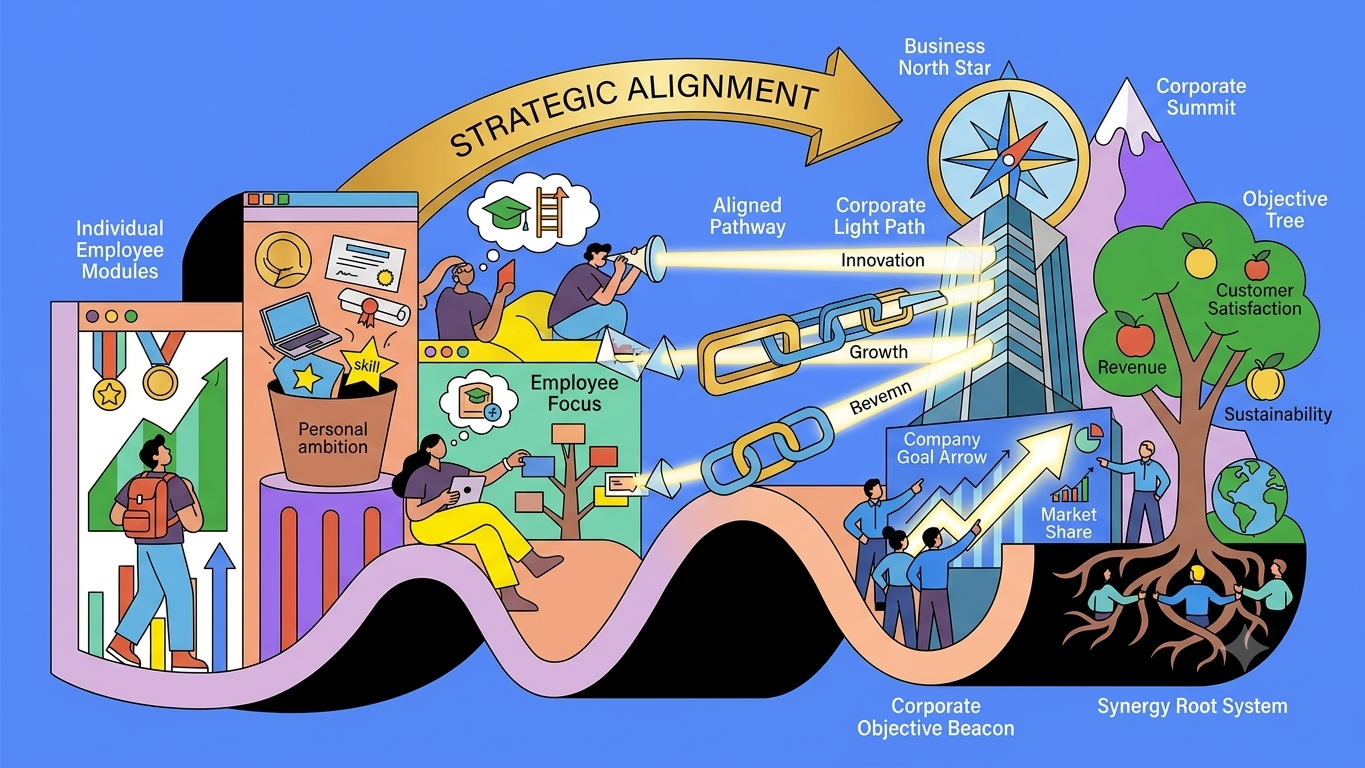
Most strategies do not fail in the boardroom. They fail in the last mile, in the space between what leaders intend and what people actually do on a Tuesday morning. A well-crafted plan is presented, applauded and filed. Then the organisation carries on more or less as before, with teams pursuing their own priorities, departments pulling in different directions and employees quietly wondering how any of it relates to their work.
This gap between strategy and action has a name: misalignment. It is one of the most common and least visible obstacles to growth, because everyone is busy and nobody is obviously slacking. The effort is real. It is simply scattered.
The encouraging news is that alignment can be diagnosed and improved in a systematic way. This article explains what alignment really means, how to find out where your organisation stands and five practical levers that leaders and HR teams can use to align employees with company goals.
What Alignment Really Means
Alignment is often confused with communication. Leaders announce the goals, and they assume that employees are aligned. But hearing about a goal is only the first step. True alignment has three layers, which can be remembered in plain text as know, believe and act:
Know: Employees understand the company’s goals and can explain them in their own words.
Believe: Employees see why the goals make sense and feel a sense of commitment to them.
Act: Employees’ daily decisions, priorities and behaviours actually move the organisation toward the goals.
Many organisations achieve the first layer, some reach the second and few sustain the third. Alignment is only real when it shows up in what people do, especially when nobody is watching.
The Cost of Misalignment
Misalignment rarely announces itself, but it leaves clear traces. Watch for signs such as these:
• Teams complete their own goals but the company’s overall results do not improve.
• Departments compete for resources or blame one another when things go wrong.
• Employees give very different answers when asked about the company’s top priorities.
• Urgent requests constantly disrupt planned work because priorities are unclear.
• Strong performers feel their work does not matter, and their energy fades.
• Decisions are slow because people are unsure what to optimise for.
Each of these signs represents wasted effort, and the waste compounds over time. A misaligned organisation can work extremely hard and still make little progress.
First, Diagnose: A Quick Alignment Audit
Before trying to fix alignment, find out where the gaps are. A simple audit takes only a few days and provides valuable insight.
Choose a cross-section of employees from different levels, teams and locations. Ask each of them a few questions, in plain text:
• What are the company’s top three goals this year, in your own words?
• How does your own work contribute to them?
• What is your team’s single most important priority right now?
• Do you believe these goals are the right ones? Why or why not?
• What gets in the way of working toward them?
Compare the answers. Then look for the type of gap that appears, since each requires a different remedy. The four common gaps are, in plain text:
Knowledge gap: People do not know or cannot explain the goals. The remedy is clearer, simpler and more frequent communication.
Belief gap: People know the goals but doubt them, or do not see why they matter. The remedy is honest explanation, involvement and listening.
Capability gap: People believe in the goals but lack the skills, tools or authority to act on them. The remedy is training, resources and clearer decision rights.
System gap: People know, believe and are able, but the organisation’s structures, processes or rewards push them in a different direction. The remedy is redesigning those systems.
Most organisations find a mixture of gaps. The audit shows which ones matter most, so that effort goes where it will have the greatest effect.
Five Levers for Aligning Employees With Company Goals
Here are the levers in simple text, so they can be used as a checklist:
Lever 1: Make the strategy simple and keep it visible
Lever 2: Translate goals into shared team priorities
Lever 3: Align structures, processes and decision rights
Lever 4: Align people practices with the goals
Lever 5: Equip managers and involve employees
Lever 1: Make the Strategy Simple and Keep It Visible
A strategy that cannot be explained simply will not be understood widely. The first step is to reduce the goals to a handful that people can remember.
Apply the “hallway test”
Imagine an employee bumping into a leader in a corridor. Could the employee, in half a minute, explain what the company is trying to achieve this year and why? If not, the
message is probably too complicated, too long or too abstract.
Explain the reasoning, not just the target
People commit to goals they understand. Share the thinking behind the choices: what has changed in the market, what customers need, what trade-offs the leadership considered. When employees see the logic, they are more likely to accept difficult priorities.
Repeat, and keep it two-way
One announcement is never enough. Leaders should return to the goals regularly in team meetings, updates and one-to-one conversations, using different examples and stories. Invite questions and concerns, and respond honestly. Communication that flows both ways builds understanding and reveals misunderstandings early.
Lever 2: Translate Goals into Shared Team Priorities
Company goals are too broad to guide daily choices. Each team needs to know what the goals mean for its own work.
The best practice is to combine cascading with co-creation. Leaders share the company goals, and each team proposes how it can contribute and what it will focus on. Managers then review the proposals across teams to check that they fit together, that important areas are not neglected and that teams are not pursuing conflicting aims.
Here is a simple example in plain text:
Company goal: Improve customer retention this year.
Customer service team priority: Resolve issues faster and reduce repeat complaints.
Product team priority: Fix the top three sources of customer frustration.
People team priority: Train front-line staff in handling difficult conversations.
Notice that different teams contribute in different ways, but all point in the same direction. It also helps to create a few shared goals across departments, so that teams
succeed or fail together and are less likely to work in silos.
Lever 3: Align Structures, Processes and Decision Rights
Sometimes employees understand and believe in the goals, but the organisation itself makes it difficult to act on them. Reporting lines create delays. Approval processes are
too slow. Budgets are set to reward something other than the stated priorities. Two departments own overlapping responsibilities.
Leaders can ask simple questions to find such obstacles, in plain text:
• Does our structure make it easy or hard for teams to work together on our priorities?
• Are the people closest to customers or problems allowed to make decisions quickly?
• Do our budgets and resource choices reflect our stated goals?
• Are there processes that made sense once but now slow us down?
• Is it clear who is accountable for each major goal?
Removing structural obstacles is often the fastest way to release energy that is already present in the organisation. It also sends a powerful message: leaders are willing to change the system, not only to ask people to work harder within it.
Lever 4: Align People Practices With the Goals
What an organisation hires for, rewards, recognises and tolerates tells employees what truly matters, regardless of what is written in strategy documents. If these practices contradict the stated goals, employees will follow the practices.
A coherent HR strategy links the people agenda to the business strategy. It asks what capabilities the goals require, how the organisation will hire and develop them and
what behaviours it wants to encourage. Alignment then becomes built into the way people are managed, not added on top.
Here are the key areas to check, in plain text:
Hiring: Are we selecting people who have the skills and values that our goals demand?
Onboarding: Do new joiners learn the goals and their part in them early?
Goal setting: Do individual objectives clearly connect to team and company priorities?
Rewards and recognition: Do we reward the outcomes and behaviours we say we value, including collaboration, or only individual results?
Development: Are learning opportunities focused on the capabilities we need for the future?
Evaluate in a way that reinforces the goals
A fair and transparent employee performance evaluation shows employees what really counts. When it considers contribution to shared goals, not only personal targets, and when feedback is honest and regular, people learn to focus on what matters to the organisation. Where evaluation rewards something else, alignment quietly breaks down.
Keep rules consistent with the message
Clear and consistent HR policies and practices also reinforce alignment. If the organisation says it values customer focus but its rules make it hard for front-line staff to resolve problems, or says it values collaboration while rewarding only individual results, the mixed message will be noticed. Reviewing policies against the stated goals often reveals small contradictions that are easy to fix.
Lever 5: Equip Managers and Involve Employees
Managers are the most important link between strategy and daily work. Employees usually hear about goals from leaders occasionally, but they discuss their work with their manager constantly.
Give managers what they need
Ensure managers understand the strategy and the reasoning behind it before it is shared more widely. Give them simple talking points, examples and time to discuss the goals with their teams. Train them to hold conversations that connect individual work to the larger picture.
Involve employees in shaping how goals are achieved
People support what they help to create. Invite employees to suggest ways of achieving goals, identify obstacles and improve processes. Front-line staff often see
practical barriers that leaders cannot see, and involving them builds both better solutions and stronger commitment.
Recognise alignment when you see it
When someone makes a decision that supports the company’s goals, especially when it involves a trade-off or extra effort, acknowledge it and explain why it mattered. This
reinforces the behaviour and shows others what alignment looks like in practice.
A Simple Communication Cadence
Alignment is maintained through rhythm. Here is a sample cadence in plain text that can be adapted to any organisation:
Annually: Set or refresh the company goals. Explain the reasoning to everyone.
Quarterly: Review progress, adjust priorities and update team goals.
Monthly: Hold an open update where leaders share results and challenges honestly and take questions.
Weekly: Team meetings cover priorities, progress and obstacles.
Regularly: Managers hold one-to-one conversations linking individual work to team and company goals.
Common Barriers and How to Overcome Them
Silos. Teams focus only on their own goals. Remedy: create shared goals and joint planning across departments.
Mixed messages from leaders. Different leaders describe different priorities. Remedy: agree on the message at the top before sharing it, and check that leaders use consistent language.
Change fatigue. Employees have seen too many initiatives come and go. Remedy: focus on fewer priorities, follow through and be honest about progress.
Distance in hybrid or multi-location teams. People feel disconnected from the centre. Remedy: use regular, structured communication, and make sure remote and site-based colleagues get the same information at the same time.
Front-line exclusion. Goals are shared with office staff but not with those working in operations, on sites or with customers. Remedy: design communication for every group, in the right language, format and timing.
How to Measure Alignment
A few simple indicators, in plain text, can show whether alignment is improving:
• The share of employees who can correctly describe the company’s top goals.
• The share who can explain how their own work contributes.
• Consistency of priorities described by different team members.
• Progress toward company goals, alongside progress toward team goals.
• Employee feedback on clarity, trust in leadership and understanding of decisions.
Repeat the alignment audit every six months or so, and share the results with employees along with what will be done in response.
Common Mistakes to Avoid
• Assuming that one announcement creates alignment.
• Setting too many priorities, so that nothing stands out.
• Cascading goals downward without listening to what teams see on the ground.
• Leaving systems, rewards and processes unchanged, while asking for different behaviour.
• Neglecting managers, then expecting them to champion the strategy.
• Treating alignment as a one-time project instead of an ongoing habit.
A Practical 60-Day Plan
Days 1 to 15, diagnose: Run the alignment audit with a cross-section of employees. Identify which types of gap appear most strongly.
Days 16 to 30, clarify: Simplify the company goals to a handful of clear statements. Prepare managers with talking points and reasoning. Hold a leadership session to agree
on consistent messages.
Days 31 to 45, translate: Ask each team to define its priorities in support of the goals. Review them across teams for fit and conflict. Create at least one shared cross-
team goal.
Days 46 to 60, reinforce: Check one or two systems, such as goal setting, rewards or approval processes, for contradictions with the goals. Start the regular communication cadence. Plan the next audit.
Bringing It All Together
Aligning employees with company goals is not a communications exercise. It is a leadership discipline that involves clarity, translation, systems and daily behaviour. It requires leaders to make the strategy simple, to listen as much as they explain, to remove the obstacles that stand in people’s way and to make sure that hiring, rewards, evaluation and policies all point in the same direction.
When these pieces come together, something valuable happens. Employees stop guessing what matters and start making better decisions on their own. Teams stop pulling in different directions and start reinforcing one another. And the organisation discovers that much of the energy it needed for growth was already there, waiting to be pointed the same way.