
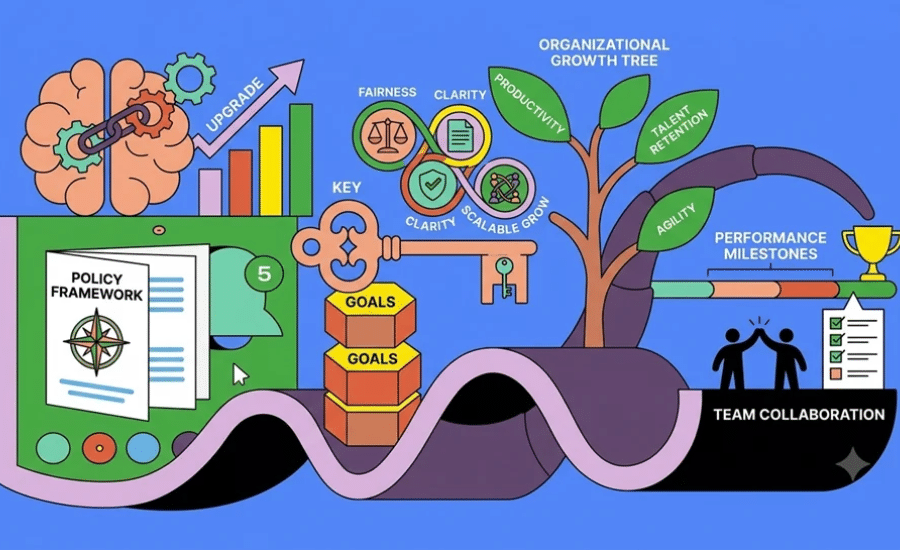
Ask employees what they think of company policies, and you may hear a sigh. For many, policies are documents that live in a shared folder, written in dense language, consulted only when something goes wrong. For many managers, they are constraints that slow decisions. And for many leaders, they are a compliance chore to be completed and forgotten.
This view is understandable, and it is costly. In a fast-growing Indian enterprise, where headcount rises quickly, operations span several states and expectations from employees are changing, policies can be one of the most powerful tools for enabling growth. Well-designed policies give people clarity, protect the organisation, reinforce fairness and let managers make decisions with confidence. Poorly designed ones create confusion, inconsistency and risk.
This article offers a practical framework for designing policies that perform: policies that are compliant, clear, fair and built to grow with the enterprise. It is written with the Indian context in mind, where regulatory complexity and workforce diversity make the design task both more demanding and more rewarding.
A note before we begin: this article provides general information and is not legal advice. Requirements differ by state, industry and company size, and they change over time. Always confirm the current position with qualified legal advisors.
Why Policies Are a Growth Lever, Not Just a Rulebook
A rulebook tells people what they cannot do. A high-performance policy framework does something more useful: it helps people do the right thing quickly, consistently and confidently.
Consider what happens without it. A manager in one city approves a request that a manager in another city would reject. An employee is unsure whether a certain kind of leave applies to them and hesitates to ask. A new joiner receives promises that the organisation cannot keep. Each small inconsistency erodes trust, and each one takes time to resolve.
With a strong framework, the opposite happens. Decisions become faster because the rules are clear. Employees feel treated fairly because the same principles apply to everyone. Leaders spend less time on avoidable disputes. And the organisation can add people, locations and businesses without reinventing its approach each time.
So what makes a policy “high-performance”? Here are six qualities, in plain text:
Compliant : It meets legal and regulatory requirements wherever the organisation operates.
Clear : It is written in plain language that a new joiner can understand.
Fair : It applies consistently, and exceptions are handled openly.
Aligned : It supports the strategy, values and culture of the enterprise.
Usable : Managers and employees can find it, understand it and apply it in daily work.
Adaptable: It can be reviewed and updated as the business and the law change.
What Makes Policy Design Different in India
Designing policies for an Indian enterprise involves considerations that a copied template from elsewhere would miss. Here are some of the most important, in plain text:
Multi-state operations. Employment rules such as working hours, holidays, leave and registrations often differ from state to state. A single national document may need state-specific annexures.
An evolving labour law landscape. India has been consolidating many older labour laws into four labour codes, and central and state rules have been moving at different speeds. Leaders should verify the current position for each state in which they operate, and design policies that can be updated as the position changes.
Statutory benefits and contributions. Provident fund, employees’ state insurance, gratuity, bonus and maternity benefits carry specific requirements that policies must reflect accurately.
Workplace safety and dignity. Obligations relating to the prevention of sexual harassment at the workplace, including the constitution of an internal committee where applicable, and to occupational health and safety, need to be built into policy and practice.
Data and privacy. Employee data is sensitive. Policies should reflect India’s data protection requirements and sound practices for handling personal information.
A diverse and multigenerational workforce. Employees vary widely in language, region, background and expectations. Policies must be understandable and respectful across this diversity.
Recognising these factors early prevents costly redesign later.
A Five-Layer Framework
Here is the framework in simple text, so it can be used as a checklist:
Layer 1: Anchor policies in strategy and values
Layer 2: Build the compliance foundation
Layer 3: Design the core policies across the employee lifecycle
Layer 4: Make policies usable
Layer 5: Govern, measure and renew
Each layer builds on the one before it. Skipping ahead, for example writing detailed rules before agreeing on principles, is a common cause of policies that are long but ineffective.
Layer 1: Anchor Policies in Strategy and Values
Before drafting a single clause, ask what the policies are meant to achieve. The answer should connect directly to where the enterprise is heading and what it stands for.
Here are questions worth answering in plain text:
What kind of workplace do we want to be known for?
What behaviours do we want to encourage, and which do we want to prevent?
Where do we need consistency, and where do we need flexibility?
How will our growth plans, such as new locations or businesses, affect our people rules?
From the answers, write a short set of design principles. For example: “We treat similar situations similarly.” “We prefer clear principles over long lists of rules.” “We give managers guidance and trust them to use judgment.” These principles become the compass for every later decision, and they are useful when a situation arises that no policy anticipated.
Layer 2: Build the Compliance Foundation
Compliance is not the whole of good policy, but it is the floor beneath it. In a fast-growing enterprise, gaps tend to appear at the edges: a new location, a new category of worker, a change in the law that nobody tracked.
A simple compliance foundation, in plain text, includes:
A list of registrations, filings and statutory contributions that apply to each entity and location.
Correct appointment and contract documentation for every category of employee.
Working hours, leave and holiday practices that reflect the rules applicable in each state.
Mechanisms for preventing and addressing workplace harassment, and for handling grievances.
Accurate record keeping, including attendance, pay and leave.
Assign clear ownership, review the position at least annually and take professional legal advice for areas of doubt. Treat compliance as a routine discipline, not an annual scramble.
Layer 3: Design the Core Policies Across the Employee Lifecycle
A helpful way to organise policies is to follow the journey an employee takes through the organisation. This ensures nothing important is missed and makes the framework easy to understand. Here is the lifecycle in plain text:
Attract and hire: Recruitment, selection, equal opportunity, referrals and background verification.
Onboard: Joining formalities, probation, induction and early expectations.
Pay and benefits: Compensation principles, statutory benefits, reimbursements and allowances.
Time and leave: Working hours, attendance, holidays, leave types and flexible or hybrid work.
Conduct and ethics: Code of conduct, conflicts of interest, confidentiality, data protection and use of company assets.
Performance and development: Goal setting, feedback, promotions, learning and career growth.
Wellbeing and inclusion: Health and safety, support in difficult times, dignity at work and diversity.
Grievance and discipline: How concerns are raised, investigated and resolved, and how misconduct is handled fairly.
Exit: Resignation, notice, handover, final settlement and exit conversations.
Use a consistent structure for every policy
Each policy should follow the same simple format so readers know where to look. In plain text, a useful template is:
Purpose: Why this policy exists.
Scope: Who it applies to.
Policy statement: What the organisation expects and commits to.
Roles and responsibilities: Who does what.
Process: The steps to follow.
Exceptions: How special cases are decided and by whom.
Review date and owner: When it will be updated and who is responsible.
Once drafted, these individual policies can be compiled into a single, well-organised
HR policies manual with a contents page, version control and a clear owner. This gives HR teams, managers and auditors one trusted source of truth.
Layer 4: Make Policies Usable
A perfect policy that nobody reads or understands achieves nothing. Usability is where many frameworks fail, so it deserves deliberate attention.
Write in plain language
Use short sentences and everyday words. Explain terms that might be unfamiliar. Where the workforce speaks several languages, consider offering key policies in more than one.
Translate policies into a friendly guide
A full policy manual is a reference document. Employees also need something more approachable. A well-written employee handbook summarises the most important policies in a warm, readable form, adds the organisation’s story and values and answers common questions. It is often the first document a new joiner reads, so its tone shapes their first impression of the culture.
Equip managers
Managers are the daily face of policy. Train them on the key policies, on how to apply judgment within them and on when to seek guidance from HR. A manager who understands the reason behind a rule can explain it convincingly, and can handle exceptions consistently.
Make policies easy to find
Keep the current versions in one accessible place, such as an intranet or employee portal, with a simple search function. Record employee acknowledgement of key policies at joining and when they change. Provide a short frequently asked questions page for the most common issues.
Layer 5: Govern, Measure and Renew
Policies age quickly in a growing business. Without a governance routine, they drift out of date, and the gap between what is written and what actually happens widens.
Set up simple governance
Name an owner for each policy. Agree on a review cycle, typically once a year and whenever the law or the business changes materially. Maintain a change log that records what changed, when and why. Involve legal, finance, operations and employee representatives where relevant, since good policies draw on several perspectives.
Close the gap between the written and the lived
The true test of a policy framework is whether HR policies and practices match. If the manual promises flexibility, but managers routinely refuse it, employees will trust the
practice, not the paper. Periodic checks help: talk to employees and managers, review a sample of decisions and audit whether processes are being followed.
Measure what matters
A handful of simple indicators can show whether the framework is working. In plain text:
Number and type of recurring employee queries, which reveal unclear policies.
Compliance exceptions found in internal checks or audits.
Time taken to resolve grievances and the level of satisfaction with the outcome.
Consistency of decisions across locations and managers.
Manager and employee understanding of key policies, tested through short surveys.
Scaling Across Locations: A Central Core With Local Annexures
As enterprises expand across cities, states and businesses, a practical approach is to build a central core of policies that reflects the organisation’s principles and applies everywhere, with local annexures that capture state-specific or site-specific requirements.
The core provides consistency and identity. The annexures ensure compliance and practicality on the ground. When a new location opens, or a new business is acquired, teams need only add or adapt an annexure instead of rewriting everything. This structure keeps the framework manageable as the enterprise grows.
Common Mistakes to Avoid
Copying templates from other organisations or countries without adapting them to the Indian and local context.
Writing policies in dense legal language that employees cannot understand.
Creating rules for every imaginable situation, instead of clear principles and sound judgment.
Failing to train managers, then blaming them for inconsistent application.
Leaving policies unreviewed for years while the business and the law change.
Treating policy design as a one-time project, instead of an ongoing discipline.
Making exceptions for senior people that would not be made for others, which quickly destroys credibility.
A Practical 90-Day Roadmap
Days 1 to 30, assess: Gather all existing policies and documents. Map where the organisation operates and which rules apply. Identify gaps, overlaps and outdated content. Talk to managers and employees about which policies cause confusion.
Days 31 to 60, design: Agree on design principles. Prioritise the policies with the highest risk or impact. Draft them using a consistent template and plain language. Involve legal advisors for compliance-sensitive areas.
Days 61 to 90, launch and embed: Compile the policies into an organised manual and a friendly employee guide. Train managers. Publish everything in one accessible place, record acknowledgements and set the first review date.
Bringing It All Together
For a growing Indian enterprise, policies are not paperwork. They are part of the infrastructure that allows the organisation to scale: a shared understanding of how people are treated, how decisions are made and how the business protects itself and its employees.
The five-layer framework offers a simple path: anchor policies in strategy and values, build a solid compliance foundation, design the core policies across the employee lifecycle, make them genuinely usable and keep them alive through governance and review. Enterprises that follow this path find that policy becomes less of a burden and more of a foundation, one that supports faster decisions, greater fairness and more confident growth.