
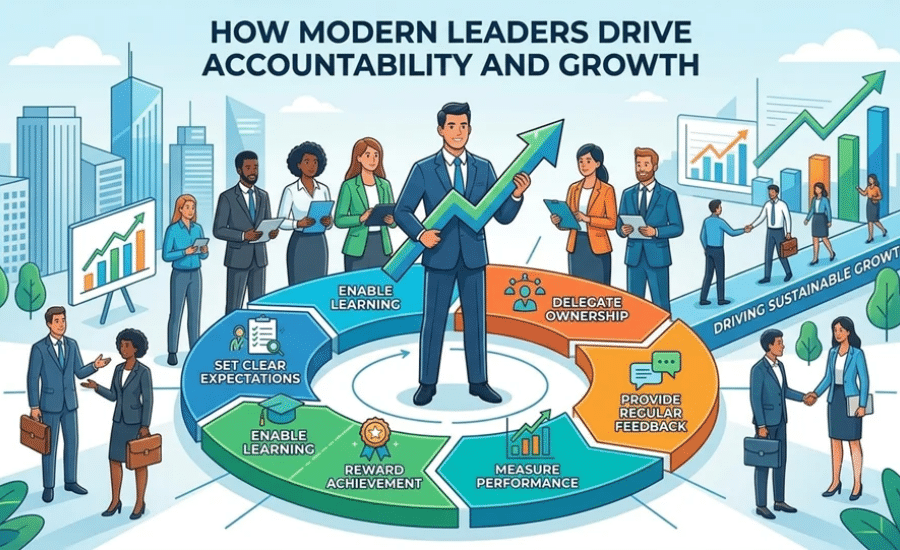
Most organisations today are rich in measurement. Dashboards glow with numbers. Scorecards are reviewed every month. Targets are cascaded from the boardroom to the shop floor. And yet, many leaders admit to a nagging feeling: despite all this data, people do not always take ownership, results still surprise them and growth stalls in places where the numbers looked healthy.
The reason is simple. Key performance indicators, or KPIs, are valuable tools, but they are not the same thing as accountability, and they are not a strategy for growth. A number can tell you what happened. It cannot, by itself, make someone care about what happens next.
Modern leaders understand this distinction. They keep the discipline of measurement, but they build something around it: clear ownership, honest conversations, healthy behaviours and a genuine commitment to learning. This article explores what KPIs do well, where they fall short and six practices that help leaders move beyond them.
What KPIs Do Well, and Where They Fall Short
Let us be fair to KPIs. They bring clarity, focus and a shared language for progress. They make it harder to hide behind vague claims. In plain text, here is what they do well:
• They turn broad ambitions into specific, measurable targets.
• They make it easier to compare progress over time and across teams.
• They highlight problems early, when the trend is visible.
• They give people a clear sense of what is expected.
But KPIs also have limits, and those limits become dangerous when leaders forget them.
Six Ways KPIs Can Mislead
1. They invite gaming. When people are judged on a number, they find the shortest path to that number, which is not always the path that serves the business. A support team measured only on call duration may rush customers off the phone. A sales team measured only on volume may discount heavily and damage margins.
2. They create tunnel vision. What is measured gets attention, and what is not measured gets neglected. Quality, collaboration, learning and customer trust are hard to reduce to a figure, so they often fade from view.
3. They look backwards. Most KPIs report on results that have already happened. By the time a figure turns red, the opportunity to prevent the problem may be gone.
4. They ignore how results are achieved. Two people can hit the same number in very different ways: one by building lasting relationships, another by cutting corners. The number alone cannot tell them apart.
5. They can feel disconnected. A target set far from the front line may seem arbitrary to those expected to deliver it. Without a clear link to purpose, it becomes a burden rather than a goal.
6. They can create false precision. A figure to two decimal places creates an impression of certainty, even when the underlying data is rough or the causes are complex.
None of this means abandoning measurement. It means recognising that measurement is the starting point of accountability, not the whole of it.
Redefining Accountability: From Blame to Ownership
In many organisations, accountability has an unfortunate reputation. It is associated with blame, punishment and the search for someone to hold responsible when something goes wrong. That version of accountability produces fear, hiding and defensiveness, the opposite of what leaders want.
Modern leaders treat accountability differently. They see it as ownership: a person’s willingness to commit to an outcome, follow through and take responsibility for learning when things do not go as planned. Here is a simple comparison in plain text:
Accountability as blame asks: Who is at fault?
Accountability as ownership asks: What did we commit to, what happened, and what will we do now?
The difference is not soft. Ownership sets a higher bar than blame, because it expects people to act before problems appear, not just to explain them afterwards. But it also creates the conditions in which people can be honest, since admitting a problem early becomes an act of responsibility, not an admission of guilt.
True accountability has three ingredients, in plain text:
Clear expectations: People know exactly what they are responsible for, and by when.
Real ownership: They have the authority, resources and trust to act.
Honest follow-through: Progress is reviewed regularly, and both success and failure lead to learning.
KPIs help with the first ingredient. The other two depend on leadership.
Six Practices of Modern Leaders
Here is the approach in simple text, so it can be used as a checklist:
Practice 1: Balance the “what” with the “how”
Practice 2: Pair results with leading indicators
Practice 3: Choose fewer, clearer goals
Practice 4: Make commitments visible and regular
Practice 5: Hold better performance conversations
Practice 6: Turn misses into learning, and accountability into growth
Practice 1: Balance the “What” With the “How”
Results matter, but the way they are achieved matters too. Leaders who look only at the numbers may reward behaviour that harms the organisation in the long run.
A simple way to balance the two is to assess every role on two dimensions. In plain text:
The “what”: Outcomes delivered, measured against agreed goals.
The “how”: Behaviours shown, such as collaboration, integrity, customer focus, learning and respect for colleagues.
Someone who delivers strong results while damaging trust is not a high performer, and someone who behaves admirably but never delivers is not one either. Making both visible tells employees that the organisation cares about the full picture.
Practice 2: Pair Results With Leading Indicators
Lagging indicators, such as revenue or customer churn, tell you the outcome. Leading indicators tell you what is likely to happen next, and they are the things teams can influence directly.
Here is a simple example in plain text:
Lagging indicator: Customer retention this year.
Leading indicators: Number of customer check-in conversations completed each month, speed of resolving complaints and customer satisfaction after service.
By tracking leading indicators alongside results, leaders can spot trouble early and teams can see how their daily actions connect to the larger outcome. This shifts accountability from explaining the past to shaping the future.
Practice 3: Choose Fewer, Clearer Goals
When everything is measured, nothing feels important. Many teams carry a long list of indicators, each of which competes for attention. Modern leaders simplify.
A helpful format is to pair a clear objective with a small number of measurable results. Here is an example in plain text:
Objective: Become the most reliable supplier for our key customers.
Result 1: Deliver 95 percent of orders on time.
Result 2: Reduce the number of order errors by half.
Result 3: Reach an agreed level of customer satisfaction in the annual survey.
An objective explains the direction and the purpose. The results show how progress will be judged. Together they create meaning as well as measurement. Aim for a handful of objectives at each level, so that people can remember them without opening a spreadsheet.
Practice 4: Make Commitments Visible and Regular
Accountability weakens when commitments are vague or forgotten. It grows when they are stated openly and revisited often.
Many effective teams hold a short weekly meeting, sometimes just fifteen minutes, where each person shares three things: what they committed to last week and how it went, what they are committing to this week and where they need help. This simple rhythm creates a healthy sense of mutual responsibility. It also brings obstacles to the surface early, when they are still easy to remove.
The tone matters. The purpose of the meeting is to help each other deliver, not to catch each other out. When leaders respond to a missed commitment with curiosity and support, people learn to report honestly.
Practice 5: Hold Better Performance Conversations
Numbers can start a conversation, but they cannot replace one. Regular, thoughtful discussions between managers and team members are where accountability becomes real.
Make feedback continuous
Do not wait for an annual meeting. Short, specific and timely feedback, given in the moment or soon afterwards, is far more useful. Describe what you saw, explain its effect and discuss what could be done next.
Make evaluation fair and rounded
A meaningful employee performance evaluation goes beyond a single score. It considers results and behaviours, gathers input from more than one perspective, takes account of circumstances beyond the person’s control and looks ahead to growth as well as looking back at the past. Fairness in evaluation is what makes accountability feel legitimate to employees.
Ask, do not only tell
Good managers ask questions such as: What are you most proud of this quarter? What got in your way? What would you do differently? What support do you need? These questions invite ownership and reveal insights that no dashboard can show.
Practice 6: Turn Misses Into Learning, and Accountability Into Growth
Missed targets are inevitable. How leaders respond determines whether people hide problems or share them.
A short learning review after a significant miss can help. In plain text, the questions are:
• What did we set out to do?
• What actually happened?
• What caused the difference?
• What will we change, and who will own it?
This approach treats failure as information about the system, not just a judgment on the person. Over time, it builds a culture in which people take smart risks, raise issues early and improve continuously.
Accountability Needs Support to Produce Growth
Accountability alone does not drive growth. It works when it is paired with support. A useful way to think about it is to combine two dimensions: the level of standards and the level of support. In plain text, the four combinations look like this:
High standards, low support: Pressure. People feel stressed, hide problems and burn out.
Low standards, high support: Comfort. People feel cared for, but little is achieved.
Low standards, low support: Apathy. People disengage and drift.
High standards, high support: Growth. People are challenged and helped to succeed, and they learn and improve.
Modern leaders aim for the last combination. They expect a great deal, and they provide the coaching, resources, clarity and encouragement that make it possible to deliver.
Building the System Around the Leader
Individual leaders can do a great deal, but they work best within an organisation that reinforces the same principles. A well-designed performance management system supports this by linking goals to strategy, encouraging regular conversations, capturing both results and behaviours and connecting performance with development. The design should serve learning and fairness, not just record-keeping.
A thoughtful HR strategy ties these elements together. It ensures that managers are selected and trained for their ability to lead people, that rewards recognise contribution to teamwork as well as individual results and that data is used to support decisions, not to replace judgment. When the wider system and the everyday behaviour of leaders point in the same direction, accountability feels natural instead of forced.
A Quick Self-Check for Leaders
Leaders can ask themselves these questions in plain text:
• Do my team members understand not only their targets but also why they matter?
• Do we look at behaviours as well as numbers when we assess performance?
• Do people feel safe telling me about problems early?
• Do I respond to misses with curiosity, or with blame?
• Do I provide the support and resources people need to meet the standards I set?
• Do I hold myself accountable in the same way I ask others to be?
Common Pitfalls to Avoid
• Adding more indicators whenever a new problem appears, until nobody can remember them.
• Linking rewards to a single measure and being surprised by the gaming that follows.
• Using data to punish instead of to learn.
• Setting high standards without providing the means to meet them.
• Holding others to account while exempting oneself.
• Treating accountability as an annual event instead of a weekly habit.
A Practical 90-Day Plan
Days 1 to 30, review: List your team’s current indicators. Ask which ones drive useful behaviour, which are ignored and which invite gaming. Talk to team members about what feels fair and what feels arbitrary.
Days 31 to 60, simplify and add balance: Reduce the goals to a manageable few. Add leading indicators for the most important results. Define the behaviours that matter and discuss them openly.
Days 61 to 90, build the rhythm: Start a short weekly commitment meeting. Introduce regular one-to-one conversations. Hold your first learning review after a miss. At the end of the period, gather feedback and adjust.
Bringing It All Together
KPIs are not the enemy. They are a useful compass, but no one reaches a destination by staring only at the compass. Reaching it requires people who understand where they are going, feel responsible for the journey and trust the leaders guiding them.
Modern leaders keep the discipline of measurement and add what numbers cannot supply: meaning, ownership, honest conversation and support. They ask not only whether the target was hit, but how it was achieved, what was learned and who has grown along the way. That is how accountability stops being a burden and becomes a source of energy, and how measured performance turns into lasting growth.